
FOOTBALL FAN TRAVEL GUIDE: FLUMINENSE FC – VISITING THE MARACANÃ STADIUM (RIO DE JANEIRO)
Updated: Jul 23
FOOTBALL FAN TRAVEL GUIDE: FLUMINENSE FC – VISITING THE MARACANÃ STADIUM (RIO DE JANEIRO)

The Maracanã isn’t just a stadium — it’s a pilgrimage. A football cathedral wrapped in Rio heat, samba noise, and a fan culture that feels alive in your chest. Visiting for a Fluminense home match is one of the most atmospheric, emotional, and surprisingly welcoming experiences anywhere in world football.
Many of the world's very best players have played in this iconic stadium: Pele, Neymar, Maradona, Zico, Garrincha, Ronaldinho, Lionel Messi, Eusebio, John Barnes, Wayne Rooney, Bobby Charlton, David Beckham, Toni Kroos, Clarence Seedorf, Thomas Muller, and we could go on and on...
This guide gives you the real fan view for this iconic venue: where to sit, how to get there, what’s safe, what’s not, and how to actually enjoy the day like a local. We’ve dug deeper into the practicalities, the nuances of Tricolor culture, and the lessons learned from travellers and locals who’ve done it multiple times.

1. Stadium Overview
The official name is Estádio Jornalista Mário Filho, better known simply as the Maracanã. Its current capacity sits around 78,000 (after being renovated between 2010 and 2013 for the 2014 FIFA World Cup and the 2016 Summer Olympics) though in its raw 1950s glory it once held over 170,000 roaring souls.
Located in the Maracanã district of Zona Norte in Rio de Janeiro, it is shared by Fluminense and Flamengo, with occasional other tenants. The away section is usually the Sector Visitante in the upper tier behind one of the goals, though the exact spot can shift slightly depending on the fixture and policing arrangements.
The Maracanã sits in a busy, working-class neighbourhood with a massive transport hub right outside. It is one of the easiest stadiums in South America to reach and one of the most intimidating to look at from the outside, with its vast concrete bowl and history etched into every corner. Matchdays are heavily policed and well organised, and the energy shifts quickly from urban grit to pure carnival once the fans pour in.
For visitors and tourists, it is a bucket-list experience that truly delivers on scale, noise, and raw emotion.

2. Getting There
The metro is generally recommended. Take Line 2, the Green line, straight to Maracanã Station, which drops you directly at the stadium footbridge. From the usual tourist destinations of Ipanema or Copacabana, change at Botafogo or Central. The journey usually takes between 25 and 35 minutes from the South Zone. After the match, trains run late on game days but get packed, so expect singing and crowds all the way back. This option is fast, safe, and full of fellow fans from both sides. It completely avoids Rio’s notorious traffic chaos, and travellers consistently rate it as seamless. Frankly though, I am claustrophobic, and it is not my idea of fun to be crammed like sardines into a moving underground box!
We went to two games while we were in Rio - one for the league and one for South America's Copa Libertadores. One had a crowd of c. 28,ooo people and the other had more than 60,000 in attendance. We took Uber both times and it worked just fine. The first game we went to had a much smaller crowd and we got there very early - like around 90 mins before kick off. For that game the Uber dropped us off literally outside our entrance with no problems. For the next game with a much bigger crowd we were later, arriving within 1 mil/1.6km of the ground about 45 mins before kick off. It was then quicker to walk the last 15-20 mins to the ground. Still though, Uber was fine. It cost us c. 75 Brazilian Real (equivalent to about $14.50 usd / £11 GBP / €12.50.
Road closures are common, so ask the driver to drop you at Maracanã Metro Station or a nearby landmark. Budget extra time and cash, especially with surge pricing. Walking any distance is not recommended, as the areas surrounding the Maracana are not considered entirely safe. The immediate area is fine on heavily policed matchdays but not ideal for tourists wandering after dark. Honestly, we didn't have any issues whatsoever anywhere in Brazil - we toured favelas, spent time at the beach, walked down Centro (downtown) and walked a mile to the Maracana stadium, we had no issues and felt safe at all times - although to be fair - I weigh c. 266lb / 120kg at over 6 ft (185cm), and have trained extensively in fighting, so maybe I look and act like someone not worth targeting, even though I'm clearly a Gringo in Brazil! But normally there are good reasons for people saying to be careful with personal safety and we don't want you to have any problems while you're in Rio!
(PS if you're at all interested in self defence/martial arts, we have 2 other Blogs you might like: https://www.realworldselfdefensetips.com/
Buses exist but tend to be slower and more confusing for first-timers. A useful pro tip is to buy a pre-loaded metro card such as Bilhete Único or RioCard in advance to save time and hassle at the gates.

3. Buying Fluminense/Maracana Tickets
Fluminense’s ticketing system remains notoriously awkward for foreigners. It involves mandatory facial biometric registration, linking your Face ID to the ticket, along with CPF requirements on the official site and spotty acceptance of international cards.
The best option for tourists is using a specialist service such as Gringo Outdoor. These outfits are officially connected to the clubs, handle ID registration and English support, and provide secure digital delivery. No Brazilian CPF is needed, and reviews are consistently strong for hassle-free entry. Buying directly through Fluminense’s official channels is possible via their website, app, or physical points like the club shop in the Copacabana area around Rua Álvaro Chaves or Laranjeiras. However, expect foreign card rejections, Face ID setup glitches, long queues at stadium booths, and occasional limits on tickets per person.
The verdict is clear: if you are not Brazilian or lack local help, use a specialist service and save yourself the stress. I can't tell you what it costs a local to buy a ticket, but for tourists, realistic prices are c. $70USD via Gringo Outdoor, with seats mostly in the lower east seatring section (arguably the best views). Derbies like Flamingo-Fluminense sell out fast and command higher prices.
To be more specific - we bought tickets for both fixtures we attended from Gringo Outdoor https://www.gringooutdoor.com/tickets They were so helpful!
But before you get to buying the tickets, you need to register your face for the Fluminense ticketing system - yep, that's right, your ticket is actually your face! They use facial recognition systems to check your face at the turnstile, which I understand was introduced to: 1. Keep banned hooligans out. 2. Reduce ticket scalping 3. Make the turnstiles move quicker.
Below is a picture of the facial scanners used:

At the time of writing, you can register your face with Fluminense here:
Once you have done that you can book your ticket via Gringo Outdoor.
They will not only register your ticket/face, but they will also share their match day guide with you, I won't undermine their service offering by sharing too many details, but will say that they do recommend to walk a few hundred metres to a nearby petrol /gas station to get Ubers to pick you up.
The other thing that Gringo Outdoor did for us was to make sure that we got back safely which was a nice touch. We didn't need to ask for any help, but we know that they would have been there if we needed them. All in all would give them 10/10.
4. The Fluminense Matchday Atmosphere
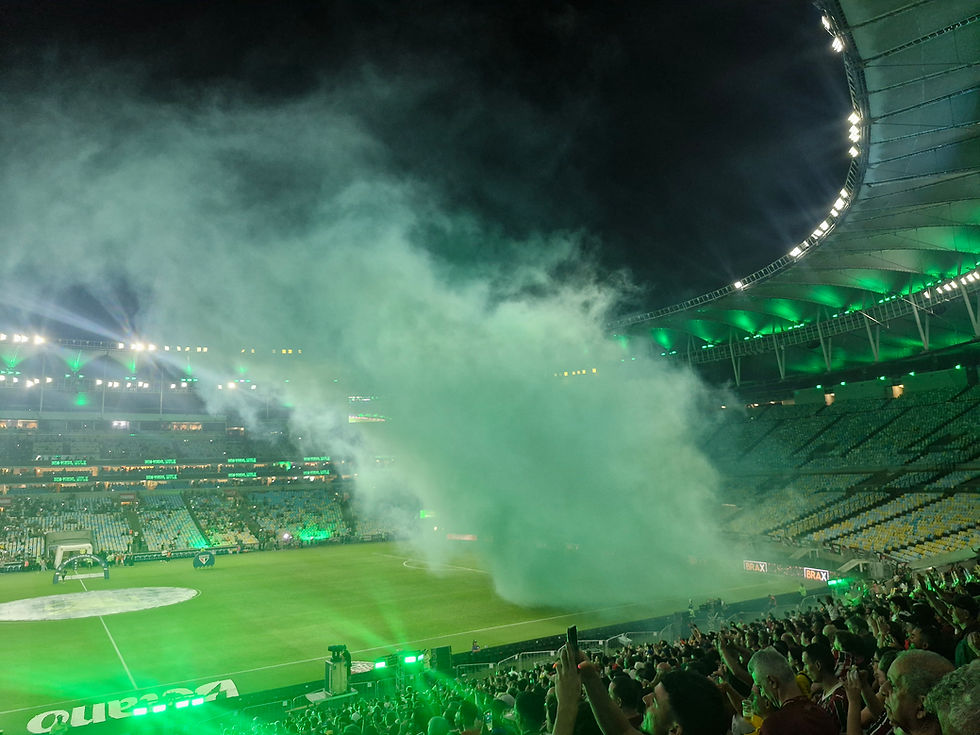
Fluminense fans, known as the Tricolores, are loud, rhythmic, and deeply emotional. Their ultras groups, notably Young Flu alongside Força Flu and others, bring drums, massive bandeirões, flares in the biggest games, and literally non-stop singing. The atmosphere carries less raw aggression than some South American ultras and more musical, communal passion. You can expect over 90 minutes of continuous support, choreographies and tifo displays during derbies or high-stakes matches, and a genuine mix of families, old-school fans, and organised groups all creating one voice in the stands. There is classic Brazilian flair with dancing in the aisles, call-and-response chants, and pure joy or heartbreak at full time.
I would genuinely say that the crowd noise and atmosphere we experienced at the Maracana stadium is about as good as it gets!
Compared to European matches, the Maracanã feels like a carnival with a competitive edge. The Tricolor support has a sophisticated reputation, proud of the club’s elite roots yet fiercely working-class in its loyalty. Fla-Flu derbies crank the intensity to another level, blending class rivalry with city pride. Stay until the end for the post-match songs, which often turn the whole experience into an impromptu concert.
5. Where To Sit
The Visitante (visitors) section is typically in the upper tier behind a goal. It is segregated with barriers and police lines, offering good sightlines and basic facilities - probably best avoided if you are a tourist. We sat with the home fans and it was great. Security checks are heavy but generally fair, and movement in and out is controlled. For neutrals or those seeking a calmer experience, consider the Sector Sul, which is more relaxed and great for families and first-timers. The Sector Leste provides excellent views and a lively but not overwhelming vibe. The Sector Oeste is premium, better shaded, and slightly quieter, making it ideal if comfort matters more than full immersion.
The seats in the Lower East stand where we sat for both games were not assigned i.e. it was a free for all, so arrive early to get the best seats. Also, we found the seats to be quite dirty with footmarks, dust and who knows what, so if you are pristine about your clothing, maybe bring something to sit on to avoid mess and don't wear white on your lower half perhaps!
6. Safety & Practical Tips
Rio rewards street-smarts. The Maracanã matchday bubble is heavily policed and generally fine, but this is a city with real contrasts - there are some really nice areas, but also a lot of people living in poverty, so be respectful and sensible and you should be fine - don't flaunt big wads of cash, expensive watches, handbags etc.
Stick with crowds and use the metro and you should be fine. Keep valuables minimal and your phone in a secure pocket outside the stadium. Rely on Uber for late returns to your hotel. Most tourists choose to base themselves in the trendy beach suburbs of Ipanema and Copacabana. Bring cash in small notes for snacks, merchandise, and street vendors because card machines often fail. Arrive 60 to 90 minutes early to handle queues and Face ID checks.
Avoid wandering the Maracanã neighbourhood alone at night. Do not wear away colours prominently on public transport after the match. Leave large bags behind as they are often refused at the turnstiles. Do not expect European levels of organisation and instead embrace the beautiful chaos. Overall, thousands of tourists attend without issue every season when they stay alert.

7. Food & Drink
Inside the stadium you will find Skol or Brahma beer, served as 0% alcohol on certain days for safety reasons apparently, but there were guys walking round with big containers of full alcohol beer on their backs when we visited - just look out for guys shouting out 'Chop! CHop!" and beckon them over if you wanna beer. The iconic mate, a sweet iced tea, is a must-try. Try the cachorro-quente, a hot dog loaded with crisps and extras, or salgados such as pastel, coxinha, or empada. Outside, street vendors rule the area with cold beers, churrasco skewers, burgers, and grilled snacks. It is cheap, fast, and very much part of the pre-match ritual, although don;t hold us accountable if any of it doesn't agree with your digestive system! Many fans organise barbecues near the stadium or in gathering spots.
One key point - bring water because it gets hot and sweaty inside the bowl. We were there in May, which is typically a cooler month in Rio, but one of the games was played in 28 degrees celcius (82 fahrenheit) and 80% humidity, which was frankly quite a lot for a pasty looking English man! They do let you bring water into the ground, but they make you take the top off the water, which is very annoying - but they sell sealed cartons of drinking water inside at a reasonable cost.
8. Best Pre-Match Areas
Fluminense fans gather around several key spots. Praça Varnhagen in Tijuca offers bars, grills, and a lively atmosphere that feels relatively safe with locals, perfect for authentic vibes. The Maracanã Metro Footbridge and its surroundings fill early with street beers, drums, and raw energy. For tourists, Ipanema and Copacabana provide safer hubs with excellent food and bars before you head north via metro. Many guided experiences start here with a local beer and a briefing. Joining locals for a pre-match bar stop is one of the best ways to soak in the culture, but keep your wits about you and remember your personal safety protocols.

(A look down Ipanema beach)
9. Where to Stay
The top bases for football travellers are Ipanema, which is the safest with the best restaurants, beaches, and overall vibe plus solid metro links. Copacabana is cheaper and lively - both of those famous beach suburbs have a metro access to the Maracanã. Botafogo attracts a trendier, younger crowd with excellent bars and transport connections. Avoid staying right by the stadium, where options are limited and not particularly tourist-friendly outside of matchdays.
10. Real Fan Tips from Locals and Travellers
Bring your passport/ID (photo of them should suffice) because digital tickets often require checks. Sit on the aisle if you plan to stand and move with the crowd, since Brazilians rarely stay seated. Respect the ultras by not filming them directly in their faces. Learn a few chants beforehand or pick them up quickly once inside. For derbies, the atmosphere reaches another level, so plan accordingly. The metro or Uber ride back with fans becomes part of the memory. Stadium tours are available on non-matchdays if you want to explore the history without the chaos, although the real magic is the matchday atmosphere, so a tour is ok, but definitely second best!
11. Final Word
A Fluminense match at the Maracanã is pure football romance. Noisy, sweaty, chaotic, emotional, and utterly unforgettable. The Tricolores’ passion, the stadium’s history, and Rio’s unique energy combine into something special that lingers long after the final whistle. If you are building a list of must-do stadiums before you die, this one sits near the very top. Go once, and you will understand why so many keep coming back.
All the best and have a great time!
Reecey
Want to book cheap flights, accommodation and tickets? We have a partnership with Expedia offering you great rates on your bookings, just click here to search and book
Affiliate Disclosure: This post may contain affiliate links. We may earn a commission on qualifying purchases at no extra cost to you.
