The 10 Hardest Tickets to Get in European Football (and How to Actually Get Them)
The 10 Hardest Tickets to Get in European Football (and How to Actually Get Them)
There is a particular kind of heartbreak known only to the football traveller: you have booked the flights, you have booked the hotel, and you are refreshing a ticket portal at 09:59 on a Tuesday morning watching a queue counter climb past 40,000.
Some tickets in European football are hard to get because demand is enormous. Others are hard because of bureaucracy — fan cards, membership tiers, loyalty points, ID checks. And a few are hard because the authorities have simply decided you cannot have one, at any price.
This is a guide to the ten toughest tickets on the continent, and the realistic routes into each. Not "sign up for the ballot and hope." Actual mechanics, actual timelines, actual costs.
One caveat before we start: ticketing rules in European football change constantly, sometimes mid-season and sometimes mid-week. Always verify against the club's official site before you book anything non-refundable.

1. El Clásico at the Spotify Camp Nou
Why it's brutal: Barcelona came home in November 2025 after two and a half years in exile at Montjuïc, but they came home to a building site. The Camp Nou is reopening in phases as the city council signs off each new occupancy licence, which means the stadium has been operating at roughly 62,000 rather than the 105,000 it will eventually hold. Demand for El Clásico did not shrink by 40%. Supply did.
Worse, from a visitor's point of view: the club's Seient Lliure scheme — where season ticket holders release their seat back to the club for matches they can't attend, and those seats go on general sale — was suspended during the partial-capacity period. That scheme was historically the single biggest source of Camp Nou tickets for tourists. Its absence is the reason this fixture has gone from difficult to genuinely punishing.
How to actually get in: Watch the official site obsessively in the three-to-four weeks before the match; releases happen in unannounced tranches rather than one big on-sale. Set an alert. Failing that, budget for a licensed hospitality package or a reputable agency — you will pay a significant multiple of face value, but the ticket will be real. Check whether Seient Lliure has been reinstated by the time you travel; if it has, your odds improve dramatically.
Better idea: A midweek Champions League group-stage night at the Camp Nou is a fraction of the price, the stadium is still extraordinary, and you'll actually get in.
2. The Yellow Wall, Signal Iduna Park
Why it's brutal: The Südtribüne holds 24,454 standing supporters and is, by common consent, the finest single stand in world football. It is also almost entirely allocated to season ticket holders and members. Casual visitors do not get on that terrace. For high-demand fixtures — Der Klassiker against Bayern, the Revierderby, Champions League knockouts — Dortmund run a members' ballot before anything reaches general sale.
How to actually get in: There is a loophole, and it is a good one. For UEFA matches, the Südtribüne is converted to seating, which changes the allocation picture entirely and puts tickets into circulation that don't exist on a Bundesliga weekend. You'll be sitting rather than standing, and the atmosphere is a notch below a league night, but you will be on the Yellow Wall.
Otherwise: a DFB-Pokal early round is your best shot at face value through official channels. Standing tickets do occasionally surface on the club's official resale platform very close to matchday — check daily in the final 72 hours. And a regular midweek Bundesliga fixture against a mid-table side is far more gettable than the marquee games people fixate on.
Note for away fans: the visiting section is in the North Stand, opposite the Wall. Good view of it. Not in it.
3. The Champions League Final
Why it's brutal: The 2027 final is at the Riyadh Air Metropolitano in Madrid on Saturday 5 June. Around 70,000 seats. Roughly half of those disappear into UEFA's own allocation, sponsors, national associations and broadcasters before a single fan sees anything. The public ballot, which opens months before anyone knows who's playing, has odds in the region of 1 in 50.
How to actually get in: Enter the UEFA public ballot the moment it opens — it costs nothing but a few minutes and it's the only route to face value. If your club reaches the final, their internal ballot for season ticket holders and members is a far better bet than the public one, so establish that membership early in the season if you think you have a chance.
The unsentimental option is the resale market in the final 48 hours. Prices at recent finals have tended to peak roughly a week out and then soften in the last day or two as hospitality inventory gets dumped — but this is a gamble, and it's the fixture where counterfeit and cancelled tickets are most concentrated.
The honest advice: most people who travel to a Champions League final never had a ticket and never expected one. The host city, the fan zone and the build-up are the trip. Madrid in early June, with a metro stop at the stadium door, is a superb place to do exactly that.
4. De Klassieker — Ajax vs Feyenoord
Why it's brutal: Because for the away supporter, the ticket does not exist. Following a long history of violence between the two fanbases, visiting fans have been barred from league meetings between Ajax and Feyenoord since 2009. No allocation. No exceptions. It is the most famous non-ticket in European football.
Dutch football also runs strict nominal ticketing — tickets are registered to a named person, club cards are required for most sales, and ID is checked at the turnstile.
How to actually get in: As a neutral, you can buy in the home end through the home club's official channels, but you'll usually need a club card and a bit of patience with a Dutch-language portal. Register well in advance. Then dress accordingly: neutral clothing, no colours, and absolutely no visiting shirt. This is not a fixture where you announce your allegiance.
Better idea: De Kuip and the Johan Cruyff Arena are both worth the trip on any other weekend, and both clubs' European nights are more accessible and nearly as loud.
5. A Premier League Away Ticket
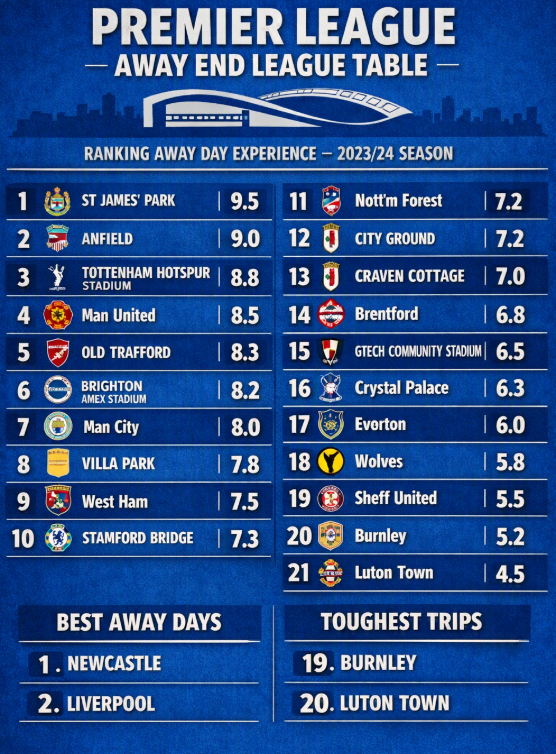
Why it's brutal: Away allocations are small — typically 3,000 or 10% of capacity, whichever is lower — and they're rationed by loyalty point systems that reward years of attendance. At the biggest clubs, the points threshold for a popular away day can require near-perfect attendance over multiple seasons. You cannot buy your way in, and that's the point.
The £30 away price cap, extended by all twenty clubs in March 2026 and now running to the end of 2027/28, makes these the best-value tickets in English football. It also makes them the most fiercely contested.
How to actually get in: Start accumulating loyalty points now, which means buying home tickets and cup tickets in seasons when nobody else wants them. It's a multi-year project. In the meantime, the accessible away days are the early cup rounds, the fixtures with awkward Friday-night or Monday-night kick-offs, and the long midweek journeys that thin the field.
Never buy a Premier League ticket from an unauthorised reseller. Ticket resale for football matches is a criminal offence in England and Wales, clubs actively cancel tickets they identify as resold, and being caught in the wrong end is the fastest way to lose your ticket, your money and your afternoon.
6. Derby della Madonnina — Inter vs Milan, San Siro
Why it's brutal: 75,000 seats and it still sells out in the members' window. Italy layers on genuine bureaucracy: tickets are nominal, ID is checked, and if you want to sit in the away sector you need a fidelity card from the away club. Some are free, some cost a few euros, and some take weeks to arrive. On top of that, the Italian Interior Ministry publishes a weekly list of fixtures deemed high-risk, and sales restrictions can be imposed on residents of the visiting region at short notice.
How to actually get in: Join the relevant club's membership scheme months in advance — that's what gets you into the presale window where the tickets actually are. For the away end, order the fidelity card as early as you can; there is no fast-track and no workaround. If you're going as a neutral, buy in a home section and keep your colours at the hotel.
Watch for the derby's on-sale date rather than assuming general sale exists — for this fixture, sometimes it barely does.
7. The Old Firm Away End
Why it's brutal: Nine years of tit-for-tat between Celtic and Rangers has reduced the away allocation at league derbies to roughly 2,000–2,500 — around 4–5% of capacity — down from the 7,000-plus that used to fill the Broomloan Stand before 2018. There have been seasons with no away fans at all. Those two thousand tickets go to the most loyal season ticket holders and supporters' clubs, and never anywhere near the general public.
There is one exception worth knowing: Scottish Cup rules allow the visiting club to request up to 20% of capacity, and in March 2026 Celtic filled the entire Broomloan Stand at Ibrox — around 7,500 — for the first time since 2018. If the draw ever pairs them in the cup again, that's your one realistic window.
How to actually get in: Realistically, as a visitor, you're looking at a home-end ticket, which requires club membership and a season or two of purchase history at either club. Failing that, treat Glasgow as the destination rather than the derby: go for a regular league fixture at Celtic Park or Ibrox, both of which are magnificent and both of which you can actually get into, and watch the derby in a pub with people who care about it enormously.
8. Athletic Club at San Mamés
Why it's brutal: Bilbao is a mid-sized city with a 53,000-seat stadium, a Basque-only signing policy, and roughly 45,000 socios. Do the arithmetic. Whatever is left after members exercise their rights is a very thin slice, and for the Basque derby against Real Sociedad or a European night, that slice is effectively zero. Membership itself has a waiting list.
How to actually get in: Athletic operate a seat-release system similar to Barcelona's, where socios return unused seats to the club for resale. Those seats appear on the official site in the days before a match, at face value, with no fanfare. It's the single best route in and most visitors don't know it exists — check daily from about ten days out.
Otherwise, target a league fixture against a lower-half opponent rather than the glamour tie. San Mamés is one of the great modern stadiums in Europe and the atmosphere doesn't require a marquee opponent.
9. Napoli at the Stadio Diego Armando Maradona
Why it's brutal: Napoli have gone from perennially underachieving to serially successful, and the city's relationship with its football club — always intense — has become something close to religious. Season tickets now cover most of the ground, general sale sells out in minutes, and the curve are effectively closed to outsiders. Add Italy's nominal ticketing and fidelity card system and you have a genuinely difficult ticket in a city that a decade ago would practically hand them out.
How to actually get in: Buy the instant tickets go on sale — this is not a fixture where you can browse over lunch. Napoli's on-sale times are published on the official site; be logged in, registered and ready before the clock starts. Distinti or Tribuna is more attainable than Curva A or B and gives you a better view of the tifo anyway.
Failing that, Napoli's European home games have historically had marginally more availability than their biggest Serie A fixtures, and the stadium on a Champions League night is one of the loudest experiences in football.
10. The Eternal Derby — Red Star vs Partizan, Belgrade
Why it's brutal: Not because tickets cost much — they're among the cheapest on this list — but because almost nothing about this fixture is predictable. Dates move. Away allocations are cut or scrapped at short notice. Matches have been ordered behind closed doors as punishment. Sales are often handled through club offices and supporters' associations rather than a slick online portal, and information in English is scarce.
How to actually get in: Go to the club offices in person, in Belgrade, in the days before the match — this remains the standard route and it works. Take cash and your passport. Buy for the home end of whichever ground is hosting; sit in the neutral sections along the side rather than behind the goals.
Give yourself a flexible return date, because the fixture genuinely can move. And read up on the current situation before you go: the derby's status changes season to season and what was true last year may not be true now.
Honourable mentions
Union Berlin at An der Alten Försterei — 22,000 capacity, a season ticket waiting list measured in years, and the most charming matchday in Germany. Marseille vs PSG — away fans are routinely banned by prefecture order, and even when they aren't, the allocation is tiny. Bayern's Südkurve — members only, effectively. The FA Cup Final — almost the entire Wembley allocation goes to the two finalists, the FA's own network and clubs at every level of the pyramid.
The 10 Hardest Tickets to Get in European Football (and How to Actually Get Them): The general toolkit
A few principles that apply across every entry on this list:
Membership is the whole game. At almost every big European club, the meaningful ticket release happens in a members-only window and general sale is either a formality or doesn't happen. Membership usually costs €30–€60 and takes five minutes. Join before you plan the trip, not after.
Official resale beats the open market. Barcelona, Athletic, Dortmund, Bayern and most major clubs run their own resale platforms where season ticket holders return seats at or near face value. These are safe, legitimate and consistently underused by visitors. Check them daily in the week before a match.
The obvious fixture is rarely the best fixture. A midweek league game or an early cup round at the same stadium delivers 80% of the experience for 20% of the hassle and cost. If your goal is to experience the ground and the city, don't fixate on the derby.
Know the local paperwork before you book flights. Italy needs a fidelity card for away sectors. The Netherlands needs a club card. Spain and Italy both check ID against the name on the ticket. None of this is difficult, but all of it takes time you won't have if you leave it to the last week.
Be extremely careful with resellers. For the fixtures on this list, the resale market is where the fraud is. Nominal ticketing means a ticket in someone else's name can and does get refused at the turnstile. If you're using an agency, use an established one, pay by a method with buyer protection, and understand exactly what you're getting.
And build a plan B into every trip. Book the flights and hotel around a city you want to visit, not around a ticket you don't yet have. If the ticket comes off, brilliant. If it doesn't, you're still in Naples, or Bilbao, or Belgrade, on a matchday, surrounded by people who are about to lose their minds one way or another. That's not a wasted weekend.
Want to book cheap flights, accommodation and tickets? We have a partnership with Expedia offering you great rates on your bookings, just click here to search and book
Affiliate Disclosure: This post may contain affiliate links. We may earn a commission on qualifying purchases at no extra cost to you.