The Away End League Table Every Premier League ground ranked for travelling fans, 2026/27
The Away End League Table Every Premier League ground ranked for travelling fans, 2026/27
Away days are still the part of English football that television cannot fake. The train, the first pint, the walk, the search, the noise, the needle, and the question of whether the home club treats you like a guest or an inconvenience. Some grounds give you a story. Some give you a concourse that smells of warm oil and a view of a corner flag.
This ranking is for the current Premier League, not last season’s. That matters. West Ham, Burnley and Wolves went down in 2025/26. Coventry City, Ipswich Town and Hull City came up. Everton now play at Hill Dickinson Stadium on Bramley-Moore Dock, not Goodison Park. Villa Park’s North Stand is closed for the whole of 2026/27 while it is rebuilt. Away tickets remain capped at £30 until at least 2027/28. The cap keeps the trip possible. It does not make every trip good.
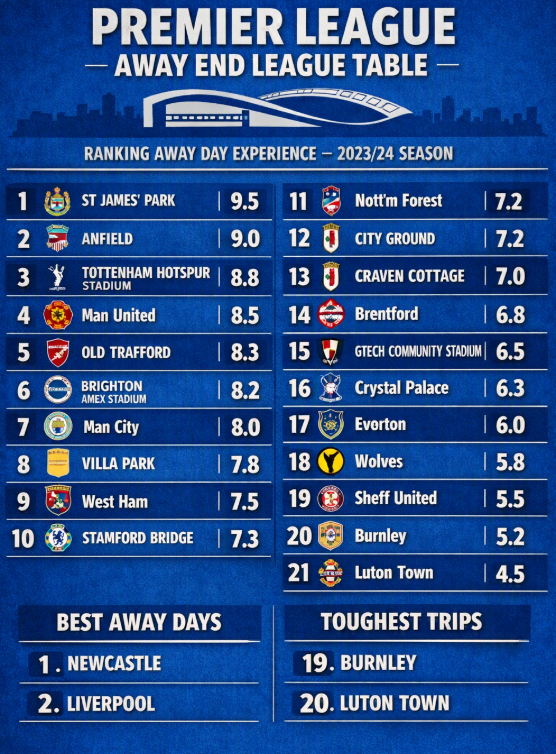
Judged on six pillars: atmosphere, safety and vibe, hospitality, matchday logistics, food and surrounding culture, and emotional impact. Scores are for the away fan, not the architect.
Newcastle United — St James’ Park Overall: 9.4/10
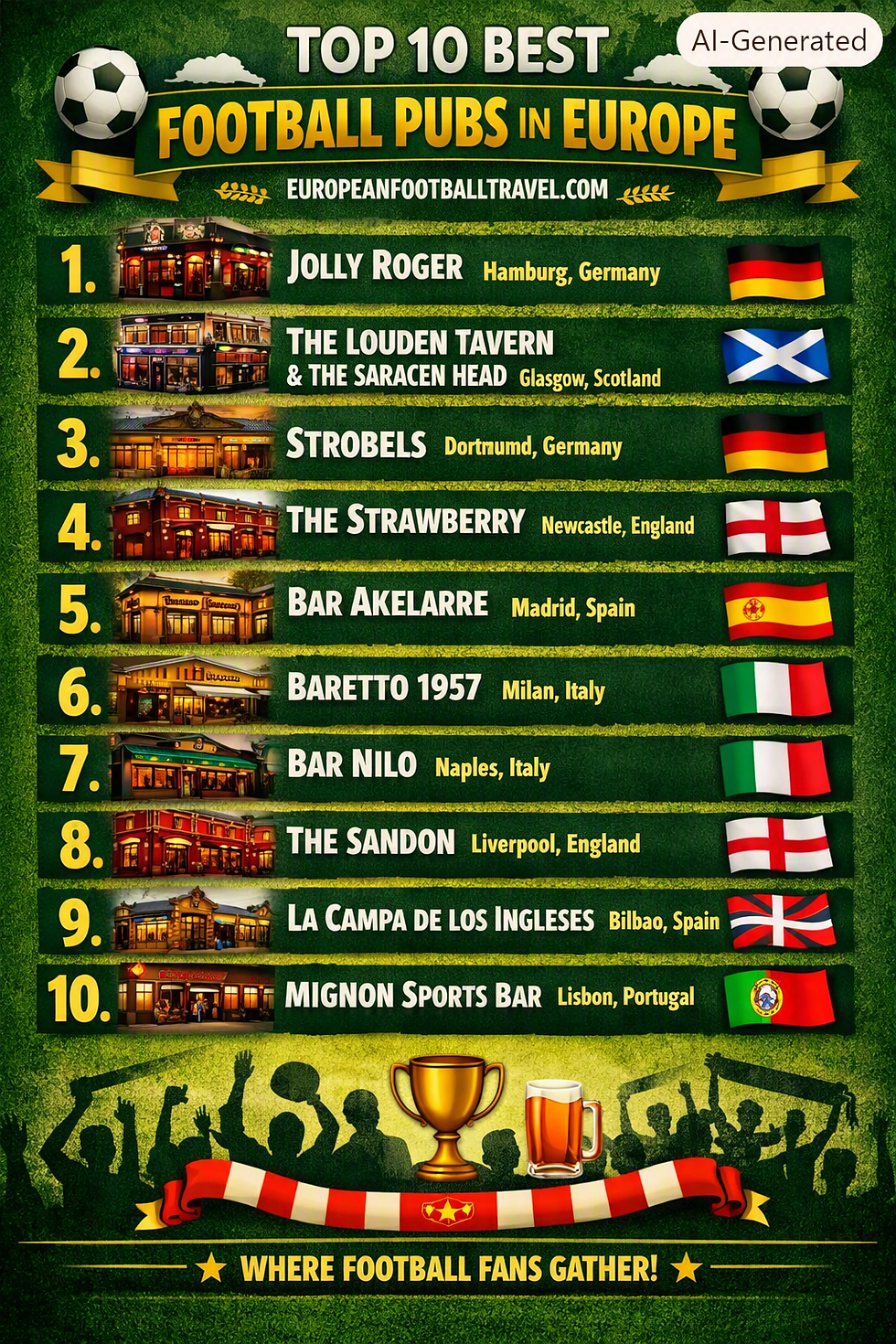
St James’ Park is still the Premier League’s great civic stadium. It sits on a hill in the middle of the city, it holds more than 52,000, and on a Saturday the whole place seems to tilt toward Gallowgate. The walk up from the station, the pubs on the way, The Strawberry, the climb into the away end: it feels like a pilgrimage rather than a retail-park appointment.
The atmosphere is relentless without usually being stupid. Locals will talk to you. They will also sing for ninety minutes. The away section is high and exposed to the weather, which in Newcastle is not a footnote, but the view is honest and the noise travels. Why it stays top: walkable, loud, iconic, and still run like a football city rather than a content studio.
Liverpool — Anfield Overall: 9.1/10
Anfield remains theatre. Walton Breck Road, the flags, the merch stalls, the last stretch past The Sandon, then the moment the Kop finds its voice. The Anfield Road expansion has pushed capacity above 61,000 and tidied facilities that used to feel pinched. You are still in a tight away corner, and you are still close enough to the home support to feel the occasion rather than watch it on a ribbon screen.
The neighbourhood is the point. This is not a stadium dropped onto a ring road. It is a football parish. Big nights here have a weight that new bowls spend a decade trying to manufacture. Why it is elite: ritual, history, and a matchday that starts three streets away.
Tottenham Hotspur — Tottenham Hotspur Stadium Overall: 8.7/10
The best-designed football stadium in the country, and it is not particularly close. Sightlines are superb, the away end is properly thought through, the concourses are wide, the food is a step above the league average, and you never spend half-time queueing for a trough. Capacity is 62,850. It looks and works like a venue built by people who had visited bad stadiums on purpose.
Atmosphere is the variable. Derby days and European nights crackle. Mid-table Saturday afternoons can feel like a very expensive demonstration model. The club has more identity in the stands than it did in the first years after White Hart Lane, but it still needs the fixture to meet the building halfway. Why it sits here: world-class comfort that has not quite erased the football.
Everton — Hill Dickinson Stadium Overall: 8.6/10
The biggest correction in this list. Ranking Everton as a crumbling Goodison away day is now a year out of date. The club moved to the waterfront in 2025. Hill Dickinson Stadium holds about 52,800, the south stand is a steep blue wall, and away fans sit in the north-east corner of the North Stand with their own concourse, rail seating in the allocation, and no pillars.
Visiting supporters who went in the first season kept saying the same things: close to the pitch, loud in the corner, facilities that make Goodison feel like a story you tell rather than a place you miss. The catch is getting there and getting away. Sandhills and the dockside approach are not Lime Street. Post-match movement can snarl, and the home atmosphere is still finding the vicious intimacy the old ground had on a wet Tuesday. The stadium itself, though, is a genuine leap. Why it ranks here: a proper football bowl, finally, on the Mersey.
Manchester United — Old Trafford Overall: 8.3/10
Old Trafford is still a pilgrimage and still a maintenance issue. The scale hits you first. Then the history. Then the leaking roof, the tired concourses, and the sense that the building has been asked to be a cathedral and a cash machine at the same time. When it gets going, few grounds in the country match it. When it does not, you notice every cracked seat.
The away end remains well placed for the spectacle and less well placed for a comfortable afternoon. The walk from the station is part of the folklore. So is the tourist layer in the home seats. You go because it is Old Trafford. That is still enough. It is no longer automatically enough to beat a new dockside bowl that works. Why it ranks: heritage and occasion, with the caveats written on the ceiling tiles.
Arsenal — Emirates Stadium Overall: 8.2/10
The Emirates used to be the case study in how to build a beautiful stadium and then spend a decade apologising for it. That era is fading. The ground is still sleek, still comfortable, still a long way from Highbury’s squeeze. The away end gives you a proper view. The atmosphere has thickened as the team has, and the Holloway and Highbury pub run remains one of London’s better pre-match circuits.
It will never feel like a dock or a hill. It feels like a well-run major venue with a football club attached, which is a compliment and a limitation. Why it is strong: premium matchday, improving noise, no hard-luck story required.
Aston Villa — Villa Park Overall: 7.8/10
In a normal season Villa Park would sit higher. This is not a normal season. The North Stand is closed for the whole of 2026/27 while Villa rebuild it toward a 50,000 ground for Euro 2028. Capacity is down around 37,000. The Holte End is still there, the club still has to give away fans the 3,000-ticket minimum, and the place can still roar. You are also watching football next to a construction site.
Witton, the walk, The Warehouse, the sense of a proper Midlands club: that has not gone. The symmetry of the old bowl has. Come back in 2027/28 and this score should move. For now, history is carrying a ground that is mid-renovation. Why it is respected: the Holte End, the culture, and a year of scaffolding.
Sunderland — Stadium of Light Overall: 7.7/10
A Wearside away day is a full trip. The Stadium of Light holds about 48,000, sits above the river, and belongs to a support that treats the Premier League as unfinished business rather than a lifestyle accessory. The bowl is 1990s modern rather than 2020s luxe, which means decent views, decent facilities, and none of the boutique intimacy of a Cottage or a Gtech.
When Sunderland are in the mood, the noise is serious. The city is the bonus: a proper Saturday, cheap enough relative to London, and a fanbase that still believes the away end is there to be drowned out. Why it lands here: scale, hunger, and a northern matchday that feels like one.
Nottingham Forest — City Ground Overall: 7.6/10
The City Ground is what people mean when they say proper football ground and do not want to be accused of nostalgia cosplay. The Trent, the Bridgford End, the cramped bits, the passion that survived the wilderness years. Away facilities are still basic. Expansion talk is loud and the building work has not yet transformed the visitor’s afternoon.
You come for the occasion and the river, not the toilets. On a night match it can feel huge for a 30,000 ground. Why it works: authenticity, a football city, and home support that has not been focus-grouped into politeness.
Brighton and Hove Albion — American Express Stadium Overall: 7.5/10
Brighton away is a good day out that sometimes pretends to be a great one. The Amex is modern, friendly, and well run. The home crowd is pleasant in a way that travelling fans underestimate until they have spent a season collecting glares elsewhere. The problem is the same as it has always been: Falmer station, the bottleneck, and a stadium that sits in a fold of the Downs rather than in the city you came to see.
Make a weekend of it and the ranking rises. Treat it as a smash-and-grab midweek and you will remember the concourse more than the sea. Why it is loved: welcome, setting, and a club that generally behaves as if visitors are allowed to exist.
Chelsea — Stamford Bridge Overall: 7.4/10
Stamford Bridge is still in Fulham, still too small for the club, and still one of the most embedded grounds in London. You feel the streets, the cemetery behind, the King’s Road somewhere beyond the merchandise. When the place is up, the compact bowl traps the noise. The away end is tight, the concourses are a lesson in how not to move 3,000 people, and the facilities have been about to be replaced for longer than some supporters have been alive.
Chelsea are still here, not in a new stadium. That fact now defines the away day as much as the badges on the wall. Why it holds: location, history, and the nights when the squeeze becomes the point.
Leeds United — Elland Road Overall: 7.3/10
Elland Road is not trying to be liked. Capacity is about 37,600. The home support is loud, partisan, and convinced the rest of the country has it in for them. For an away fan that can be magnificent or wearying, sometimes in the same forty-five minutes. Facilities are dated. The welcome can be sharp. The football culture is the real thing.
If you travel to be soothed, go to Brighton. If you travel to feel a crowd lean on a game, Leeds is in the conversation with Newcastle and Liverpool. Safety is generally fine if you have a brain. Vibes are another matter. Why it scores here: atmosphere and edge, paid for in comfort.
Manchester City — Etihad Stadium Overall: 7.2/10
The Etihad is the cleanest big-club operation in the league. Getting in is easy, the view is good, the seats work, and nobody will confuse the concourse for a 1980s away end. Atmosphere depends entirely on the opponent and the score. Title-deciders can be huge. Mid-season home games against the bottom six can feel like a well-lit demonstration of how to spend a billion pounds and still hear individual conversations.
The campus around the ground has improved the walk-up. It still does not have the pub-and-terrace grain of the city’s other football end. Why it is solid: logistics and facilities, with the noise arriving when the fixture deserves it.
Fulham — Craven Cottage Overall: 7.2/10
The Cottage is the most charming away day in the division and one of the gentlest. The Thames, the Craven Cottage pavilion, the walk from Putney Bridge, the sense that you have slipped into a different league’s idea of a ground. The new Riverside Stand has modernised a chunk of it without quite killing the oddness.
Atmosphere is the tax you pay for the setting. It can be lovely. It is rarely hostile in the way a travelling support wants on a wet Monday. Why it is unique: the river, the quirk, and a club that would rather serve you a pint than stare through you.
Ipswich Town — Portman Road Overall: 7.0/10
Portman Road is the best of the promoted returns. A town-centre ground, a short walk from the station, a Cobbold Stand away allocation, and a support that is pleased to be back without pretending it owns the league. Facilities are honest rather than glamorous. The matchday is easy to read: pubs in town, walk to the ground, watch football, walk back.
It will not blow your hair back. It will not insult you either. In a league full of out-of-town bowls, that is worth more than it sounds. Why it sits here: simplicity, welcome, and a proper civic ground.
Brentford — Gtech Community Stadium Overall: 6.7/10
The Gtech is a good small stadium. Compact, tidy, friendly, and close enough to the action that you never feel exported to the car park. The away allocation is modest, the surrounding area is still more Golden Mile than football quarter, and the whole operation can feel like a Championship club’s clever new house that happened to stay up.
Lionel Road is not Walton Breck Road. Nobody is claiming it is. For a 17,000-capacity ground it does the job with unusual good manners. Why it is fine: closeness and vibe, limited scale.
Crystal Palace — Selhurst Park Overall: 6.4/10
The Holmesdale Fanatics can make Selhurst one of the loudest rooms in the country. That is the case for the defence. The case for the prosecution is everything else: a cramped away end, tired facilities, awkward approaches, and a ground that has been due a rebuild since some of the travelling support were at school.
You go for the noise and leave talking about your knees. A new Selhurst would shoot up this list. The current one is a test of how much atmosphere you are willing to trade for comfort. Why it is mixed: serious home end, ungenerous visitor experience.
Hull City — MKM Stadium Overall: 6.2/10
The MKM is a 25,000-seat community stadium that does a competent Premier League impression. Views are clean. The bowl is tidy. The city has more about it than people who have never left the train station think. What it lacks is the sense that the building and the club grew up together.
Away days here are fine. They are rarely the fixture you circle in August. Why it sits here: modern enough, thin on romance.
Coventry City — Coventry Building Society Arena Overall: 6.0/10
Coventry’s return after twenty-five years is a joy for the club and a slightly awkward afternoon for the visitor. The CBS Arena is a 32,000-seat bowl by a retail park, with its own station, a South Stand away end of about 3,000, safe standing in part of the allocation, and a cashless concourse. Getting there is easier than the reputation of Coventry travel suggests. Feeling like you are at a historic football ground is harder.
This was built as a multi-use arena. You can sense the concerts and the rugby in the bones. Home fans are loud in Singers’ Corner. Post-match exits can involve a hold and a tramp across a car park. Why it is low: functional, out of town, and short on football texture.
Bournemouth — Vitality Stadium Overall: 5.8/10
Dean Court, still. Capacity a little over 12,000. Friendly club, tight streets, an away end that feels like a packed Championship ground that never got the memo. Intimacy is the selling point. So is the limit. You can hear everything, including the fact that there is not very much of it.
A seaside trip helps. A midweek 7.45pm in January does not. The Premier League’s smallest ground is a curiosity and a squeeze. Why it is bottom among current clubs: scale, comfort, and a ceiling the building cannot break.
There are two kinds of away day. There are the civic giants — Newcastle, Liverpool, the rebuilt Everton, the still-beating traditional grounds at Villa, Forest, Leeds and Sunderland. And there are the polished machines — Spurs, Arsenal, City — which win on toilets and sightlines and have to earn the rest.
If you want the weekend that feels like English football as sold to the rest of the world, take the train to Newcastle or Liverpool. If you want to sit in the best seat, go to Tottenham. If you want to see what a club does when it finally leaves a beloved wreck, go to Everton’s dock. The rest of the list is the usual argument between charm, noise, and whether your coat stayed dry!